
Beyond the Asphalt: Why the “All-Road” Revolution is Redefining Cycling in 2026
For decades, the cycling world was divided: you were either a road cyclist on skinny tires or a mountain biker on heavy suspension. But as we move through 2026, those boundaries have blurred into a singular, dominant trend: The All-Road Revolution.
From city commuters to weekend adventurers, riders are demanding one thing: Versatility. Here is how the landscape of the traditional bicycle is changing and why it matters for your next ride.
1. The Rise of the “Gravel” Philosophy
The hottest segment in the industry isn’t just a bike; it’s a mindset. Gravel bikes—traditional frames equipped with wider tires and stable geometry—have become the “Swiss Army Knife” of cycling.
- Adaptability: One bike that handles smooth pavement, cracked city streets, and gravel paths with equal ease.
- The 40mm Standard: We are seeing a shift where 40mm to 45mm tires are becoming the new norm, providing a “cushion of air” that makes cycling more accessible and comfortable for everyone.
2. Sustainability: Steel and Alloy are “Real” Again
In 2026, eco-conscious manufacturing is no longer a luxury—it’s a requirement. While carbon fiber was once the ultimate goal, many riders are returning to High-Quality Steel and Recyclable Aluminum.
- Longevity: A well-built metal frame can last a lifetime, reducing the “throwaway” culture of modern tech.
- Repairability: Unlike complex composites, traditional metal frames are easier to repair and recycle, aligning with the global push for a circular economy.
3. Progressive Ergonomics: Comfort is the New Aero
The trend of “suffering for speed” is fading. Today’s riders prioritize Long-Distance Comfort.
- Short-Reach Geometry: Modern frames are designed with a more upright “endurance” position, reducing strain on the neck and lower back.
- Component Innovation: We are seeing shorter cranks (160mm–165mm) becoming standard to improve pedaling efficiency and protect joint health, proving that traditional bikes are getting smarter, not just faster.
4. The “No-Screen” Sanctuary
Perhaps the most significant trend of 2026 is the psychological shift. As AI and digital connectivity saturate our daily lives, the traditional bicycle has become a “Digital-Free Zone.” Retailers are seeing a surge in “Analog Enthusiasts”—people who specifically choose mechanical shifting and cable-actuated brakes because they want a machine they can understand, maintain, and control without a software update.
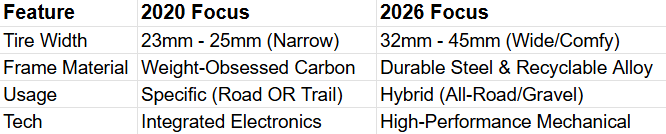
Conclusion: The Future is Versatile
The trend is clear: the modern cyclist wants a bike that can do it all. They want the reliability of traditional mechanics paired with the comfort of modern geometry. Whether you are navigating a busy industrial zone or exploring a quiet countryside path, the “All-Road” bicycle is the definitive vehicle for the mid-2020s.
Is your fleet ready for the revolution? Explore our 2026 All-Road collection today.
