

2026-2030 Global Bicycle Industry In-Depth Report | Product Advantages & Market Trends for B2B Wholesalers
Abstract
After the post-pandemic inventory adjustment, the global bicycle industry has entered a stable growth stage driven by localized product adaptation, lightweight & intelligent technology iteration, and regional policy upgrades. For overseas B2B wholesalers, the traditional profit model of reselling standardized off-the-shelf bicycles is no longer competitive. Only customized products with market-specific performance designs and complete compliance qualifications can build long-term market barriers in high-growth regions including Southeast Asia and South America.
Based on the latest 2026 industry data, global export compliance standards, and practical OEM factory cases, this report analyzes the core competitive advantages of mainstream bicycle models for emerging markets, interprets key industry trends in technology, market demand and policies, and provides actionable procurement and supply chain strategies for B2B global wholesalers.
Key Takeaways
1. Product Competitiveness Logic: High-repurchase export bicycles rely on market-adapted customization rather than low pricing or high-end configurations. Targeted design for local road conditions, climate and compliance standards is the core advantage of professional OEM manufacturers.
2. Core Industry Trends: Electrification, localization and simplification are the three major growth drivers. Electrification dominates global market increment, localization is the market entry threshold, and simplification remains the mainstream for mass consumer markets.
3. B2B Wholesaler Breakthrough Strategy: Flexible OEM customization + regional compliance qualification reserve + pre-positioned inventory layout helps wholesalers reduce supply chain risks and maximize terminal market competitiveness.
1. Core Product Competitive Advantages of Mainstream Export Bicycles
Global bicycle consumption has shifted from single functional demand to scenario-based demand. For B2B wholesalers, selecting products tailored to local road conditions, climate environments and compliance rules is the primary premise of market competition. The core advantages of mainstream export models are derived from targeted optimized designs for regional market pain points.
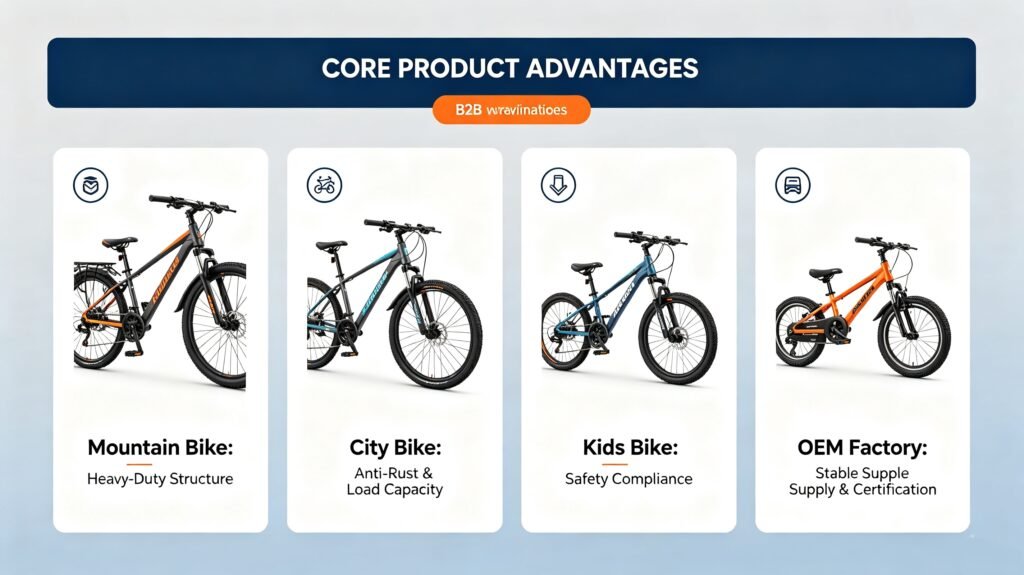
1.1 Mountain Bike: Full-Scenario Durability Customization for Complex Road Conditions
Mountain bikes are the best-selling adult bicycle category in South America and Southeast Asia. According to 2026 B2B wholesale platform data, mountain bikes account for 40% of total adult bicycle wholesale volume in South America, with full-size heavy-duty models leading the market growth. Compared with ordinary stock bikes, OEM customized mountain bikes have unique market advantages:
Reinforced Frame Structure: To adapt to gravel, bumpy and unpaved roads in South American mountainous areas and Southeast Asian rural regions, customized mountain bikes adopt thickened high-tensile steel frame pipes, improving overall structural strength by 30% compared with standard models, effectively resisting long-term impact and deformation. Mid-to-high-end models adopt 6061-T6 lightweight aluminum alloy frames, reducing overall weight by 25% while maintaining structural stability for flexible riding experience.
Upgraded Wheel & Tire System: Equipped with thickened anti-deformation aluminum rims and upgraded wear-resistant rubber tires with deeper tread patterns, providing stronger grip on loose and muddy roads. Optional puncture-proof tire inner layers greatly reduce tire damage rate in complex road scenarios, lowering after-sales maintenance costs for wholesalers.
Modular OEM Customization: Professional factories support personalized adjustments including frame pipe thickness, tire size, transmission configuration, frame painting and brand logo decals. Differentiated customized designs help wholesalers avoid homogeneous price competition and build exclusive brand advantages in local markets.
1.2 City Commuter Bike: Anti-Rust & Heavy-Load Optimization for Daily Commute Scenarios
City commuter bikes are the core mass-market products for urban areas in Southeast Asia and South America. Local end-users prioritize low maintenance cost, strong load capacity and high climate adaptability over riding speed. OEM customized commuter bikes have irreplaceable advantages over ordinary stock products:
Professional Anti-Rust Technology for Humid Climate: Adopt multi-layer high-precision spray painting and electrophoretic primer process, forming a dense anti-corrosion isolation layer on the frame surface. Welding seams are specially polished and coated with waterproof materials, effectively preventing moisture erosion. The anti-rust performance is 40% higher than ordinary models, perfectly adapting to the high-temperature and high-humidity climate in Southeast Asia and salt fog environment in South American coastal areas.
Enhanced Load-Bearing Structure: Optimized frame stress structure and thickened wheel sets support a maximum load of 150kg, meeting local users’ daily demands for carrying goods and passengers. Matched with detachable rear racks and humanized saddles, the overall practicality fully fits local daily commuting habits.
Low-Maintenance Configuration Design: Adopt simple single-speed transmission or precise internal speed change system, reducing daily maintenance difficulty for end-users. Standard complete fenders and stable braking systems adapt to frequent start-stop urban riding scenarios, ensuring durable and stable performance.
1.3 Kids Bike: Standardized Safety Customization for Regional Incremental Markets
Kids bicycles are the fastest-growing incremental category in Southeast Asian and South American markets. Market competition focuses on safety compliance and scenario-based detail optimization rather than configuration stacking. Professional OEM customized kids bikes have absolute advantages in market adaptation:
Strict Regional Safety Compliance: All structural designs comply with local mandatory safety standards. Equipped with fully enclosed chain covers to prevent clamping injuries, smooth non-sharp frame welding, and child-friendly brake systems with moderate grip force. Every finished bike passes strict load-bearing, braking and bump tests to eliminate potential safety hazards.
Regionalized Size & Configuration Matching: For Southeast Asian markets, 12-16 inch kids bikes with standard training wheels and bright color matching are mainstream. For South American markets, 18-20 inch youth bikes with shock-absorbing front forks are more popular for suburban off-road riding. Factories support flexible configuration adjustment according to regional market demand differences.
Eco-Friendly & Humanized Details: Adopt environmentally friendly non-toxic paint, polished smooth frame edges, ergonomic soft saddles and stable auxiliary wheels. The refined design improves end-user experience and helps wholesalers enhance terminal market reputation and repurchase rate.
1.4 Integrated Supply Chain & Compliance Advantages of Professional OEM Bicycle Manufacturers
For B2B wholesalers, long-term market competitiveness depends on cost control, stable supply and full compliance support, which are the core barriers of professional OEM factories:
Vertical Integrated Supply Chain: Long-term strategic cooperation with world-class component suppliers realizes centralized procurement, reducing comprehensive component costs by 18% compared with the industry average. Strict supplier screening and incoming material inspection ensure stable batch quality and avoid delivery delays caused by supply chain fractures.
One-Stop Regional Compliance Support: Targeted configuration optimization and complete certification documents are provided for different regional markets to help wholesalers pass customs clearance smoothly. Professional factories keep real-time track of global standard updates to ensure all products meet local safety and environmental protection requirements.
Flexible Production & Customized Service: Support small-batch trial orders, mixed container loading, personalized color painting, custom logo printing and exclusive export packaging. Diversified customized solutions help wholesalers flexibly adjust product portfolio according to market feedback and reduce inventory risks.
Our Core Factory Advantages for Global B2B Wholesalers: As a professional full-cycle bicycle OEM&ODM manufacturer focusing on global export, we deeply cater to the differentiated procurement needs of overseas wholesalers in Southeast Asia, South America and other high-growth regions. We independently complete frame welding, painting, assembly and quality inspection, with stable monthly production capacity to support both small trial orders and large-scale bulk orders. We have long-term matched complete product certification systems for mainstream global markets, providing one-stop customized product solutions, professional export document support and responsive after-sales spare parts service. Adhering to market-oriented product optimization, we continuously upgrade durable, low-maintenance and climate-adaptive bicycle products, helping global B2B customers reduce comprehensive operating costs and build sustainable local market competitive advantages.
2. 2026-2030 Global Bicycle Industry Core Development Trends
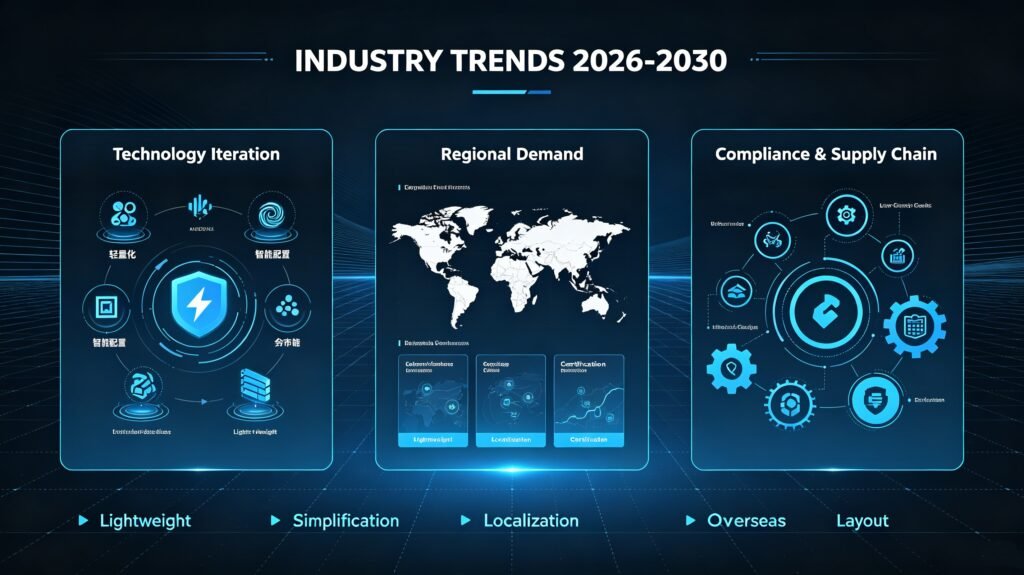
Accurate trend judgment is the key to avoiding overstocking and seizing market increments. The global bicycle industry is driven by technological iteration, market demand differentiation and policy upgrading, presenting three major development trends.
2.1 Technology Iteration Trend: Scenario-Oriented Lightweight, Simplification & Intelligence
Industry R&D no longer pursues high-end parameter stacking, but focuses on improving terminal scenario adaptability:
Lightweight Upgrade: Mid-to-high-end models adopt aluminum alloy and carbon fiber materials to reduce body weight, improving riding flexibility and lowering international transportation costs. Optimized structural design reduces the weight of traditional carbon steel models by 15% while ensuring strength.
Functional Simplification: Mass-market products abandon redundant high-end functions, adopting low-maintenance and easy-to-repair configurations. The simplified design reduces end-user usage thresholds and after-sales costs, which is more suitable for emerging markets with insufficient local maintenance resources.
Practical Intelligence: Intelligent configurations such as smart power display, global positioning and adaptive power adjustment have become standard for mid-to-high-end models, improving riding safety and product added value, helping wholesalers enhance product premium capability.
2.2 Market Demand Trend: Regional Differentiation & Scenario-Based Customization
Global market demand continues to diverge, and standardized universal products are gradually losing competitive advantages:
Southeast Asia Market: Driven by policy energy-saving incentives and short-distance travel demand, city commuter bikes and entry-level electric bikes dominate the market. Consumers prioritize cost performance, bright appearance, anti-rust performance and load capacity, with high demand for low-maintenance products.
South America Market: Benefiting from the demand for low-cost transportation tools, mountain bikes and youth bikes maintain rapid growth. Local consumers pay more attention to product sturdiness and durability, prefer sports-style appearance, and have high acceptance of simple speed change functions.
European Market: Environmental protection and healthy travel concepts drive market growth. Electric bikes and high-end scenario-based bicycles are mainstream, with extremely high requirements for product compliance, craftsmanship and detail design.
2.3 Policy & Supply Chain Trend: Rising Compliance Threshold & Localized Layout
Global trade policies and supply chain structures are reshaping the industry competition pattern:
Continuous Upgrade of Compliance Standards: Countries around the world have improved bicycle safety and environmental protection access standards. Southeast Asia, South America and Europe have successively launched mandatory certification requirements. Complete qualification documents have become essential conditions for product customs clearance and sales.
Localized Supply Chain Layout Becomes Mainstream: To reduce tariff and logistics costs, mainstream manufacturers deploy overseas assembly factories and bonded warehouses. CKD/SKD bulk export modes help wholesalers effectively reduce import costs and shorten delivery cycles.
Shift in Procurement Logic: B2B wholesalers have changed from traditional large-batch and long-cycle procurement to small-batch, multi-frequency and flexible order placement to reduce inventory backlog risks.
3. Procurement Strategy Guidelines for Overseas B2B Wholesalers
3.1 Targeted Product Selection by Region
Precisely match product configurations according to regional market pain points to build a differentiated product matrix:
Southeast Asia Market: Priority products are city commuter bikes and entry-level electric bikes. Core configurations include anti-rust frame, puncture-resistant tires, single-speed low-maintenance system, bright color matching and waterproof export packaging, focusing on cost control and after-sales risk reduction.
South America Market: Priority products are mountain bikes and youth bikes. Core configurations include thickened frame pipes, wear-resistant thick tires, anti-deformation wheel sets and simple speed change systems, focusing on product sturdiness and complex road adaptability.
European Market: Priority products are high-end electric bikes and lightweight commuter bikes. Core configurations include lightweight alloy frames, high-precision transmission and braking systems, and full compliance certification, focusing on product quality and market premium capability.
3.2 Core Selection Criteria for OEM Suppliers
Excellent supply chain partners determine long-term market profitability. Wholesalers should focus on four core capabilities when selecting factories:
Regional Customization Capability: Mature targeted configuration solutions for different markets, flexible modular adjustment capabilities, and rich experience in serving global B2B customers.
Full Compliance Guarantee Capability: Complete market certification qualifications, professional compliance teams, and one-stop document support to ensure smooth customs clearance.
Stable Delivery & Quality Control Capability: Sufficient production capacity, complete full-process QC system, and stable batch quality to avoid order delays and defective product risks.
Flexible Service Capability: Support trial order cooperation, mixed container loading, personalized customization and complete after-sales spare parts supply services.
3.3 Optimized Procurement Portfolio Strategy
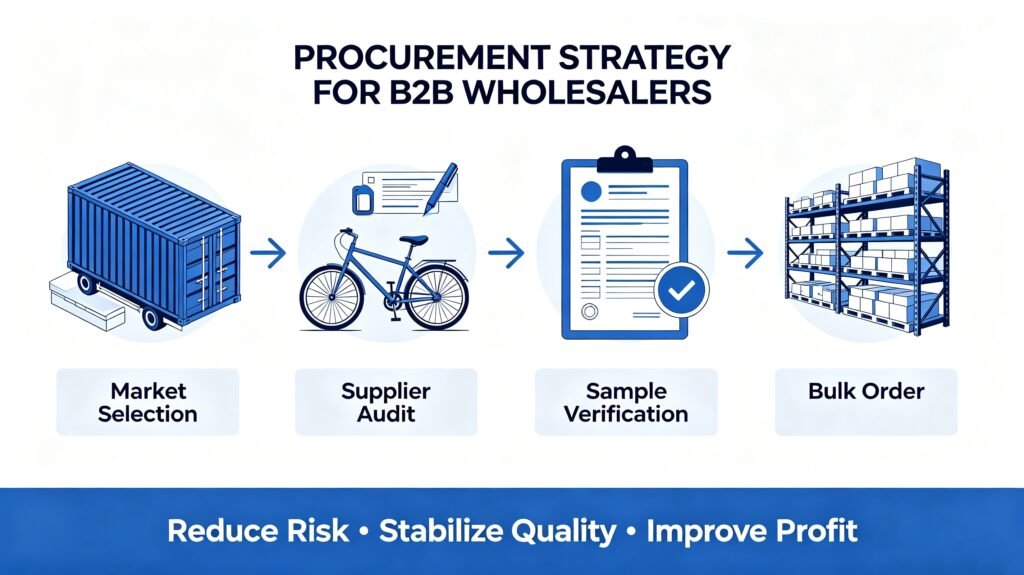
Sample Verification Before Mass Shipment: Complete market scenario tests and terminal experience verification through pre-production samples to reduce mass order trial and error costs.
Market-Driven Configuration Customization: Adjust product details according to local climate, road conditions and consumer preferences to improve terminal sales competitiveness.
Prefer Suppliers with Overseas Layout: Cooperate with manufacturers with overseas warehouses and assembly bases to shorten delivery cycles and reduce tariff and logistics costs.
Balance Flexible Trial Orders & Bulk Orders: Test market feedback with small-batch multi-style orders, and lock cost advantages with large-batch centralized procurement for best profit margins.
4. Conclusion
From 2026 to 2030, the global bicycle industry is transforming from single price competition to full-link value competition. For overseas B2B wholesalers, the core competitiveness no longer relies on channel advantages or low-price strategies, but on accurate market trend judgment, localized adaptive product selection and stable compliant supply chain support.
Working with professional OEM bicycle manufacturers to obtain market-customized products, full compliance guarantees and flexible supply chain services allows wholesalers to focus on local channel development and terminal market operation. As an experienced export-oriented bicycle factory, we tailor cost-effective, market-adaptive bicycle solutions for global B2B wholesalers, with reliable quality control, flexible order policies and complete export supporting services. This win-win cooperation mode is the most reliable way to build long-term profitable market barriers in the increasingly competitive global bicycle wholesale industry.
FAQ
Q1: What are the most profitable bicycle categories for global wholesale in 2026?
A: City commuter bikes and kids bikes maintain stable mass-market profits in Southeast Asia; heavy-duty mountain bikes and youth bikes are the most competitive categories in South America; entry-level electric bikes are the fastest-growing high-premium products in global markets.
Q2: Why customized OEM products are more competitive than standard stock bikes?
A: OEM customized products are optimized for local road conditions, climate and compliance standards, with lower after-sales rates and higher terminal adaptability. They avoid homogeneous price competition and bring higher and more stable profit margins for wholesalers.
Q3: How can B2B wholesalers reduce export bicycle procurement risks?
A: Choose manufacturers with complete compliance qualifications and stable QC systems, complete sample verification before mass production, adopt small-batch trial order strategies, and prioritize suppliers with overseas supply chain layout to reduce customs clearance, quality and inventory risks.
2026-2030 全球自行车行业深度报告
批发商产品优势、市场趋势与采购策略
摘要
后疫情时代,全球自行车行业正在从库存调整阶段进入新的稳定增长周期。本地化产品适配、轻量化与智能化升级、区域政策趋严,正在成为推动行业发展的核心力量。
对于海外 B2B 批发商而言,单纯依靠标准现货、低价铺货的利润模式已经越来越难持续。未来的竞争重点不再只是 “卖什么车”,而是产品是否能匹配目标市场的道路条件、气候环境、合规要求和终端消费习惯。
本文基于 2026 年行业趋势、全球出口合规要求以及 OEM 工厂实践经验,分析主流出口自行车的产品优势,解读行业技术、市场与供应链变化,并为海外批发商提供可落地的采购与供应链策略。
核心结论
1. 产品竞争力逻辑 高复购的出口自行车,核心不是低价,也不是盲目堆配置,而是针对目标市场做本地化定制。车架强度、防锈能力、轮胎耐磨、配件维护成本和合规认证,是专业 OEM 制造商的核心优势。
2. 行业三大趋势 电动化、本地化、简约化是未来五年的主要方向。电动化决定增量,本地化决定市场准入门槛,简约化决定大众市场的长期走量能力。
3. 批发商破局方向 灵活 OEM 定制 + 区域合规认证储备 + 前置库存布局,是海外批发商降低供应链风险、提升终端竞争力的重要路径。
一、主流出口自行车的核心产品优势
全球自行车消费已经从单一功能需求,转向场景化需求。对于海外批发商来说,能否根据目标市场选择适配产品,直接影响终端销量、售后成本和复购率。
1.1 山地车:针对复杂路况的全场景耐用定制
山地车是南美、东南亚成人自行车市场中最畅销的品类之一。2026 年 B2B 批发平台数据显示,南美地区山地车约占成人自行车批发总量的 40%,其中重型、耐用、适配复杂路况的车型增长明显。
相比普通现货车型,OEM 定制山地车具备更强的市场适配优势:
加强型车架结构 针对南美山地、东南亚乡村砂石路和非铺装路面,定制山地车通常采用加厚高拉力钢管车架,整体结构强度比标准款提升约 30%,能够更好地抵御长期冲击和变形。中高端车型可采用 6061-T6 铝合金车架,在保证结构稳定性的同时降低整车重量。
升级轮组与轮胎系统 采用加厚抗变形车圈和升级耐磨橡胶轮胎,胎纹更深,在松散路面、泥泞路面和乡村道路上抓地力更强。可选防刺轮胎内层,可大幅降低复杂路况下的爆胎率,减少批发商售后维护成本。
模块化 OEM 定制能力 专业工厂可根据不同市场调整车架管壁厚度、轮胎尺寸、变速配置、车架喷漆和品牌贴花。差异化定制有助于批发商摆脱同质化价格竞争,在本地市场建立更稳定的品牌优势。
1.2 城市通勤车:针对日常通勤的防锈与载重优化
城市通勤车是东南亚、南美城市市场的核心走量产品。当地终端用户更看重低维护成本、强载重能力和高气候适应性,而不是单纯追求速度或高端配置。
OEM 定制通勤车相比普通现货产品具备明显优势:
高温高湿环境专用防锈工艺 采用多层高精度喷漆和电泳底漆工艺,在车架表面形成致密防腐隔离层。焊缝位置经过特殊打磨和防水处理,能有效抵御湿气侵蚀,防锈性能比普通车型提升约 40%,更适合东南亚高温多雨和南美沿海盐雾环境。
增强型载重结构 优化车架受力结构,搭配加厚轮组,最大承重可达到 150kg,满足用户日常载人、载货等实际需求。配合可拆后货架和人性化车座,整体实用性更贴合当地日常通勤习惯。
低维护配置设计 采用简约单速或精密内变速系统,降低终端用户日常维护难度。标配完整挡泥板和稳定刹车系统,适应城市频繁启停的骑行场景,保证长期稳定使用。
1.3 儿童自行车:面向增量市场的安全合规定制
儿童自行车是东南亚和南美市场增长最快的增量品类之一。儿童车市场的竞争重点不是配置堆叠,而是安全合规、细节设计和场景化适配。
专业 OEM 定制儿童车在市场适配方面具备明显优势:
严格区域安全合规设计 结构设计符合当地强制安全标准,配备全封闭链罩防止夹伤,车架焊点光滑无尖锐边缘,刹车力度适中,适合儿童操作。成品需经过承重、刹车和颠簸测试,降低安全隐患。
区域化尺寸与配置匹配 东南亚市场以 12 寸、14 寸、16 寸儿童车为主,标配辅助轮,配色鲜艳;南美市场 18 寸、20 寸青少年车型需求更强,部分用户更偏好带前减震的运动款车型。工厂可根据区域需求灵活调整配置。
环保与人性化细节 采用环保无毒喷漆,车架边缘打磨光滑,搭配符合人体工学的柔软车座和稳定辅助轮。细节体验提升有助于批发商增强终端市场口碑和复购率。
1.4 专业 OEM 工厂的供应链与合规优势
对于海外批发商来说,长期竞争力不仅取决于产品本身,还取决于成本控制、稳定交付和合规支持能力。
垂直整合供应链 与世界级零部件供应商建立长期合作,实现集中采购,综合零部件成本比行业平均降低约 18%。严格的供应商筛选和来料检验,有助于保证批量质量稳定,降低供应链断裂带来的交付风险。
一站式区域合规支持 针对不同区域市场提供定向配置优化和完整认证文件,帮助批发商顺利通关。专业工厂会持续跟踪全球标准更新,确保产品符合当地安全和环保要求。
灵活生产与定制服务 支持小批量试单、混柜出货、个性化喷漆、定制 LOGO 和专属出口包装。多样化定制方案有助于批发商根据市场反馈灵活调整产品组合,降低库存风险。
对于海外 B2B 批发商而言,选择具备完整制造能力的出口型自行车 OEM 工厂,可以获得更稳定的批次质量、更灵活的订单安排和更完整的出口服务支持。
二、2026-2030 全球自行车行业核心发展趋势
准确判断行业趋势,是批发商避免库存积压、抓住市场增量的关键。未来五年,全球自行车行业主要呈现三大趋势:技术迭代、需求区域分化、合规与供应链本地化。
2.1 技术迭代趋势:轻量化、简约化与实用智能化
行业研发不再盲目追求高端参数堆叠,而是更注重终端场景适配。
轻量化升级 中高端车型更多采用铝合金和碳纤维材料,降低整车重量,提升骑行灵活性,同时降低国际运输成本。优化结构设计也使传统碳钢车型在保证强度的同时减重约 15%。
功能简约化 大众市场产品逐渐舍弃冗余高端功能,转向低维护、易维修配置。简约设计降低终端用户使用门槛,也更适合本地维修资源不足的新兴市场。
实用智能化 智能电量显示、定位、自适应助力等功能逐渐成为中高端车型的常见配置,提升骑行安全性和产品附加值,帮助批发商增强产品溢价能力。
2.2 市场需求趋势:区域差异化与场景化定制
全球市场需求持续分化,标准化通用产品的竞争力正在下降。
东南亚市场 受政策节能激励和短途出行需求推动,城市通勤车和入门级电动车占据主导。消费者重视性价比、外观颜色、防锈性能和载重能力,低维护产品需求较高。
南美市场 受低成本交通工具需求带动,山地车和青少年自行车增长迅速。当地消费者更看重产品结实耐用,偏好运动外观,对简易变速功能接受度较高。
欧洲市场 环保和健康出行理念推动市场增长,电动车和高端场景化车型是主流,对产品合规、工艺细节和设计质感要求较高。
2.3 政策与供应链趋势:合规门槛提升与本地化布局
全球贸易政策和供应链结构正在重塑行业竞争格局。
合规标准持续升级 各国不断提高自行车安全和环保准入标准。东南亚、南美、欧洲等地相继推出强制认证要求,完整资质文件已成为产品通关和销售的必要条件。
本地化供应链布局成为主流 为降低关税和物流成本,主流制造商开始布局海外组装工厂和保税仓库。CKD/SKD 散件出口模式有助于批发商降低进口成本,缩短交付周期。
采购逻辑发生变化 海外批发商从传统大批量、长周期采购,逐渐转向小批量、多频次、灵活下单,以降低库存积压风险。
三、海外批发商采购策略指南
3.1 按区域进行针对性选品
根据区域市场痛点匹配产品配置,建立差异化产品矩阵。
东南亚市场 优先选择城市通勤车和入门级电动车。核心配置包括防锈车架、防刺轮胎、单速低维护系统、明亮配色和防水出口包装,重点控制成本和售后风险。
南美市场 优先选择山地车和青少年自行车。核心配置包括加厚车架管壁、耐磨厚轮胎、抗变形轮组和简易变速系统,重点提升产品耐用性和复杂路况适应性。
欧洲市场 优先选择高端电动车和轻量化通勤车。核心配置包括轻质合金车架、高精度变速刹车系统和完整合规认证,重点提升产品品质和市场溢价能力。
3.2 OEM 供应商核心选择标准
优秀的供应链伙伴决定长期市场盈利能力。批发商选择工厂时应重点关注四项能力:
区域定制能力 是否具备成熟的不同市场定向配置方案、灵活模块化调整能力,以及服务全球 B2B 客户的经验。
全流程合规保障能力 是否具备完整市场认证资质、专业合规团队和一站式文件支持,确保顺利通关。
稳定交付与品控能力 是否具备充足产能、完整全过程质检体系和稳定批次质量,避免订单延误和次品风险。
灵活服务能力 是否支持试单合作、混柜出货、个性化定制和完整售后备件供应。
3.3 优化采购组合策略
大货前先做样品验证 通过产前样品完成市场场景测试和终端体验验证,降低大批量试错成本。
根据市场做配置定制 结合当地气候、道路条件和消费偏好调整产品细节,提升终端竞争力。
优先选择有海外布局的供应商 与具备海外仓和组装基地的制造商合作,缩短交付周期,降低关税和物流成本。
灵活试单与大单采购结合 通过小批量多款式订单测试市场反馈,再通过大批量集中采购锁定成本优势。
四、结论
2026-2030 年,全球自行车行业正在从单一价格竞争转向全链路价值竞争。对于海外 B2B 批发商来说,核心竞争力不再只是渠道优势或低价策略,而是对市场趋势的准确判断、本地化产品选型能力,以及稳定合规的供应链支持。
与专业 OEM 自行车制造商合作,获得市场定制化产品、全流程合规保障和灵活供应链服务,能帮助批发商更专注于本地渠道拓展和终端市场运营。这种共赢合作模式,将是全球自行车批发行业建立长期盈利壁垒的重要方式。
常见问题
Q1:2026 年全球批发利润较高的自行车品类有哪些?
A:东南亚市场中,城市通勤车和儿童自行车保持稳定大众利润;南美市场中,重型山地车和青少年自行车竞争力较强;入门级电动车是全球市场增长最快的高附加值产品。
Q2:为什么 OEM 定制产品比标准现货更有竞争力?
A:OEM 定制产品针对当地道路、气候和合规标准进行优化,售后率更低,终端适配性更强。同时能避免同质化价格竞争,为批发商带来更高、更稳定的利润空间。
Q3:海外批发商如何降低出口自行车采购风险?
A:选择具备完整合规资质和稳定质检体系的制造商,大货前完成样品验证,采用小批量试单策略,并优先考虑有海外供应链布局的供应商,以降低清关、质量和库存风险。